Tarak Dhurjati
1️⃣ Introduction
Carbon credits are tradable certificates representing the removal, reduction, or avoidance of one metric ton of CO₂-equivalent (tCO₂e). They are designed to incentivize climate mitigation by rewarding projects that verifiably reduce atmospheric greenhouse gas (GHG) concentrations.
Credits can be:
- Avoidance / Reduction-based: Preventing emissions that would have occurred (e.g., renewable energy, efficient cookstoves, AWD irrigation in rice).
- Sequestration / Removal-based: Capturing and storing CO₂ either biologically (e.g., mangroves, soil carbon) or technically (e.g., Direct Air Capture, Enhanced Rock Weathering).
2️⃣ Classification of Carbon Credit Projects
| Category | Example Projects | Mechanism | Key Measurement Challenge |
|---|---|---|---|
| Emission Avoidance | Renewable energy (solar, wind), improved cookstoves, Alternate Wetting and Drying (AWD) in rice, landfill gas recovery | Prevent emissions that would occur otherwise | Establishing credible baselines |
| Emission Reduction (Process Efficiency) | Direct Seeded Rice (DSR), low-emission fertilizer management, methane capture from manure | Reduce methane/N₂O via practice change | Baseline and leakage tracking |
| Nature-based Carbon Sequestration | Mangrove afforestation, reforestation, agroforestry, soil carbon regeneration | CO₂ captured and stored in biomass/soils | Permanence, leakage, monitoring |
| Technical/Engineered Removal | Enhanced Rock Weathering (ERW), Biochar, Carbon Capture and Storage (CCS), Direct Air Capture (DAC) | Permanent mineralization or injection | High cost, verification complexity |
3️⃣ Measurement of Carbon Credits (MRV Framework)
All credible programs follow MRV – Measurement, Reporting, and Verification protocols that include:
- Baseline Estimation:
Define the “business-as-usual” (BAU) scenario—what emissions would occur without the project.
Example: For AWD rice, baseline = continuous flooding with higher methane emissions. - Quantification of Reductions/Removals:
Apply standardized formulas or direct measurement tools.- Mangroves: Biomass sampling + remote sensing for soil carbon.
- ERW: Quantify weathering rate, CO₂ mineralized, and life-cycle energy use.
- Leakage Assessment:
Determine if emissions are displaced elsewhere (e.g., protecting one mangrove area causes cutting in another). - Additionality:
Demonstrate the project would not have happened without carbon finance (financial, regulatory, or common practice tests). - Permanence:
Assess risk of reversal (fires, erosion, dissolution). Manage via buffer pools or insurance (esp. for mangroves, forests). - Monitoring & Verification:
Regular data collection (field, satellite, sensors) and third-party verification at defined intervals (1–5 years).
4️⃣ Major Standards & Registries
| Registry / Standard | Focus Area | Strengths | Notes / Examples |
|---|---|---|---|
| Verra (VCS) | Broad portfolio – REDD+, agriculture, renewables, blue carbon | Global adoption, rigorous MRV | Mangrove, AWD, DSR methodologies available |
| Gold Standard (GS4GG) | Sustainable Development Goals alignment | Co-benefits and stakeholder safeguards | Soil carbon, energy efficiency |
| American Carbon Registry (ACR) | US-based, ISO-aligned | Transparent verification, strong forestry/agri protocols | Rice, soil carbon methodologies |
| Climate Action Reserve (CAR) | North America | High-quality standardized baselines | Urban forestry, Biochar |
| Puro.earth | Carbon removals only – biochar, Enhanced Rock Weathering, DAC, long-lived products | Focus on durable carbon removal (100+ year permanence) | Issues CORCs (CO₂ Removal Certificates) |
| Global Carbon Council (GCC) | Emerging global standard (CORSIA eligible) | Affordable for developing-country projects | Energy efficiency, renewables |
5️⃣ Types of Audits and Assurance Levels
1. Validation Audit (Pre-implementation)
Conducted before project registration to assess methodology, baseline, and additionality.
2. Verification Audit (Ex-post)
Independent review of monitoring data to confirm actual emission reductions/removals.
3. Surveillance / Follow-up Audits
Interim checks to ensure ongoing compliance.
4. Assurance Levels:
- Reasonable Assurance: Deep sampling, field visits, high confidence.
- Limited Assurance: Desk review, smaller samples, lower confidence (used for pilot projects).
Audit Accreditation:
Auditors (Validation & Verification Bodies or VVBs) must be ISO 14065 accredited or approved by the registry.
6️⃣ Project-Specific MRV Challenges
| Project Type | Key MRV Tools | Uncertainty / Risk Factors |
|---|---|---|
| Mangrove restoration | LIDAR, satellite NDVI, sediment coring | Reversibility (storms), tenure disputes |
| Direct Seeded Rice (DSR) | Field methane flux chambers, activity data | Farmer adoption rate, soil water control |
| Alternate Wetting and Drying (AWD) | Water level sensors, yield data | Leakage (methane–N₂O trade-off) |
| Enhanced Rock Weathering (ERW) | Lab mineral analysis, soil sampling, LCA | Verification of CO₂ uptake rates |
| DAC/CCS | Flow meters, geologic storage monitoring | Energy use, permanence documentation |
7️⃣ Audit Protocols: What Verifiers Check
✅ Conformance to approved methodology
✅ Evidence of baseline and monitoring data
✅ Additionality and leakage justification
✅ Calculation of uncertainties and conservative buffers
✅ Permanence safeguards and buffer pool contributions
✅ Public documentation and traceability (serial numbers, registry link)
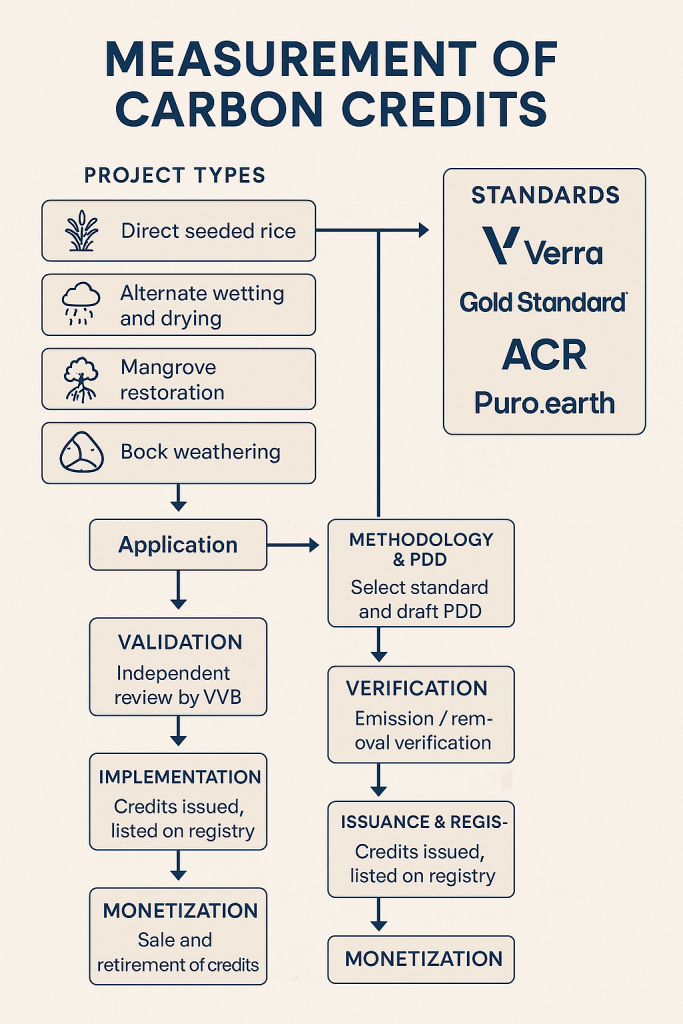
8️⃣ Process Flow — From Project to Monetization
Project Concept → Methodology Selection → Project Design Document (PDD)
      ↓
Third-party Validation (VVB)
      ↓
Project Implementation & Data Monitoring
      ↓
Verification Audit (Ex-post)
      ↓
Registry Issuance of Credits (VCUs, CORCs, etc.)
      ↓
Listing or Sale via Exchange / OTC Market
      ↓
Buyer Retirement and Corporate Disclosure
(Puro.earth credits are issued as CORCs; Verra/Gold Standard issue VCUs or GS VERs.)
9️⃣ Critical Review — Key Insights
👍 Strengths
- Established global frameworks (VCS, Gold Standard, ACR, Puro.earth) ensure methodological transparency and MRV traceability.
- Growing inclusion of agricultural innovations (DSR, AWD) and durable removals (ERW, biochar) enhances portfolio diversity.
- Puro.earth adds scientific rigor for permanent removals, avoiding issues common in nature-based credit reversibility.
⚠️ Weaknesses
- Baseline inflation and weak additionality remain systemic issues.
- Permanence risk in biological systems (mangroves, forests) undermines long-term value.
- Audit inconsistency—varying depth and independence of VVBs.
- Data transparency gaps—not all registries make field data public.
- Low farmer-level incentives—especially in DSR/AWD projects, where monitoring costs exceed credit value unless aggregated.
💡 Emerging Best Practices
- Combining satellite data + IoT sensors for real-time MRV.
- Linking digital MRV systems (e.g., Puro Connect, Verra’s Project Tracker).
- Adoption of ISO 14064-3 verification consistency.
- Using buffer pools or insurance to de-risk natural projects.
- LCA integration in engineered removals (ERW, DAC).
🔟 Conclusion
High-quality carbon credits require:
- Transparent methodologies,
- Independent, accredited audits,
- Robust MRV frameworks, and
- Conservative accounting for risk and uncertainty.
Among registries, Puro.earth stands out for durable carbon removal projects, while Verra, Gold Standard, and ACR remain critical for agriculture and ecosystem-based credits such as DSR, AWD, and mangrove restoration.
The credibility of the carbon market hinges not only on carbon quantity but on carbon integrity—ensuring that every credit represents a real, additional, and permanent tonne of CO₂ removed or avoided.
By Tarak Dhurjati-
AI Tools were used for developing the above article.

 SAMSIDDHA@AI