By Tarak Dhurjati — Special Feature Review
For over a century, plant breeders and geneticists have chased what many call the “Holy Grail of Agriculture” — the ability to produce clonal seeds from elite hybrids, indefinitely preserving hybrid vigor without repeated breeding. Today, thanks to breakthroughs in apomixis engineering, CRISPR-based meiosis control, and parthenogenesis genes, the world stands at the threshold of a seed revolution that could dramatically boost global food production.
Recent research from leading groups such as Radboud University, Max Planck Institute, and others (summarized in the 2025 Heidemann et al.,The Plant Journal (2025), review) shows remarkable scientific progress toward turning apomixis from a botanical curiosity into a practical agricultural technology.
This magazine-style review unpacks the science, the breakthroughs, the creation of one-line hybrids, and the transformative impact on future farming.
The Promise of Apomixis: Clonal Seeds Without Fertilization
Apomixis is a naturally occurring mechanism in a small fraction of plant species (less than 0.1%) where seeds develop without fertilization — essentially a form of asexual reproduction through seeds
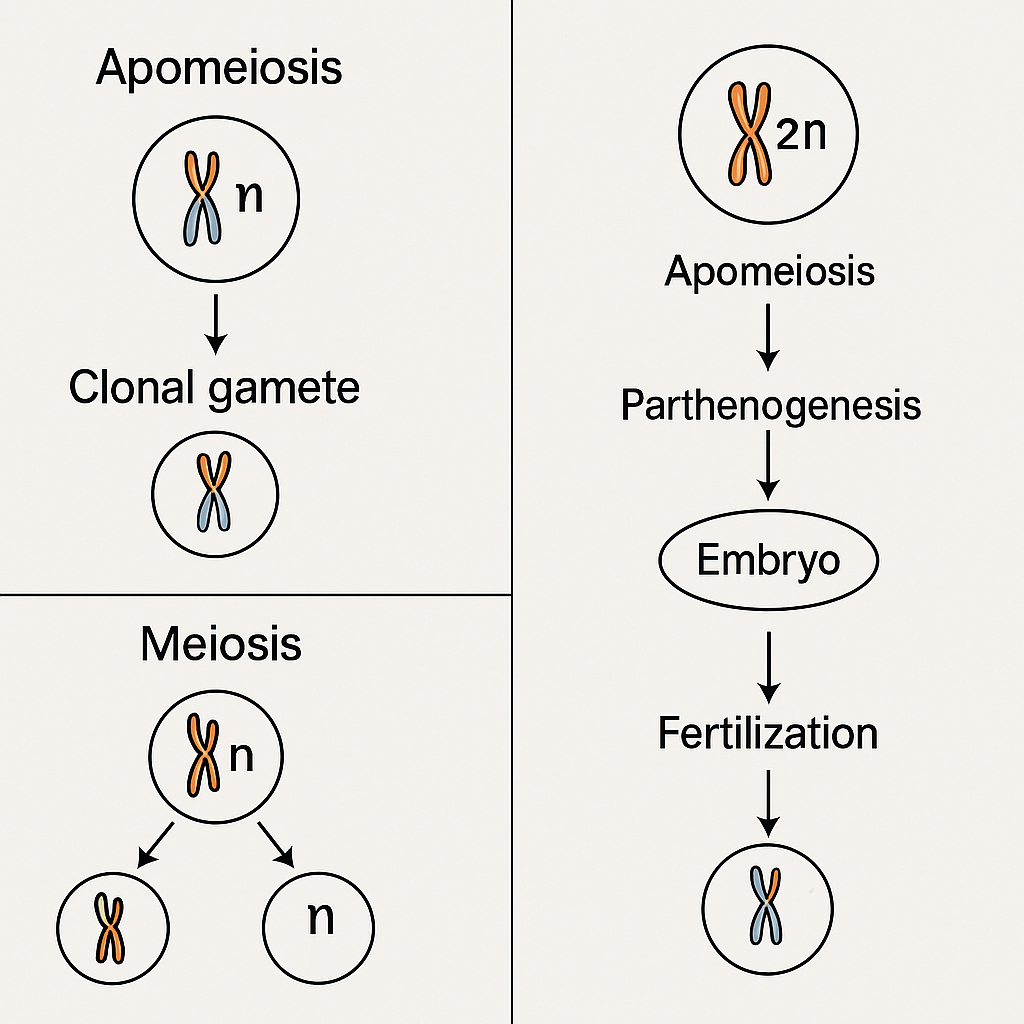
This bypasses two pillars of sexual reproduction:
- Meiosis — the genetic reshuffling step
- Double fertilization — fusion of sperm with egg and central cell
By eliminating these, an apomictic plant produces offspring that are genetic clones of the mother plant — a perfect copy, with no changes.
For agriculture, this means:
✔ Hybrid vigor can be fixed permanently
✔ Elite varieties can be propagated endlessly without breeding
✔ Farmers can save their hybrid seeds every season
✔ Uniformity and predictability become standard
The One-Line Hybrid: A Breakthrough Enabled by Apomixis
In conventional hybrid breeding, seed companies must maintain:
- A male sterile line
- A maintainer line
- A restorer line
- Controlled pollination infrastructure
This 3-line system is costly, labor-intensive, and limits hybrid access in developing countries.
Apomixis collapses this complexity into one line.
What is a One-Line Hybrid?
A one-line hybrid is an elite F1 hybrid into which apomixis genes have been engineered so that the plant:
- Produces clonal gametes (via meiosis suppression)
- Initiates embryo formation without fertilization
- Produces clonal seeds identical to the hybrid
Thus, the F1 hybrid becomes self-propagating — a single line that breeds true across generations.
This concept, for decades considered theoretical, is now becoming scientifically feasible thanks to major advances in apomixis components.
The Molecular Engineering Behind Clonal Seeds
Apomixis involves three major engineered components:
1. Avoiding Meiosis (Apomeiosis)
The game-changing MiMe (Mitosis instead of Meiosis) system replaces meiosis with a mitosis-like division. It requires disabling three meiotic genes:
- SPO11 – prevents DNA recombination
- REC8 – modifies chromosome cohesion
- OSD1/TAM – eliminates second meiotic division
MiMe has now been successfully engineered in:
- Arabidopsis
- Rice
- Tomato (a major dicot milestone, 2024)
Tomato MiMe hybrids have been shown to produce unreduced clonal gametes, enabling polyploid genome design and demonstrating feasibility in commercial horticulture crops heidemann_plant_journal_2025.
2. Parthenogenesis (Skipping Fertilization)
Successful embryo formation without fertilization is the second required step.
Proven gene triggers:
- PsASGR-BBML (BABY BOOM-like) from Pennisetum
- ToPAR from dandelion
- WUSCHEL and WOX-family genes that enhance embryo initiation
Recent findings show:
- Rice parthenogenesis rates up to 86–91% when OsBBM1 is combined with OsWOX9A — a massive improvement over earlier systems heidemann_plant_journal_2025.
- The ToPAR gene can induce parthenogenesis even in monocots like rice and foxtail millet heidemann_plant_journal_2025.
3. Autonomous Endosperm Development (Still the Hardest Step)
Most synthetic systems still require fertilization of the central cell (pseudogamy).
Progress includes:
- Manipulating PRC2/FIS complex genes
- Sperm-cell cyclin CYCD7;1 expression triggering endosperm-like tissue formation without fertilization
But autonomous endosperm is still the major bottleneck for fully fertilization-free seed development heidemann_plant_journal_2025.
Synthetic Apomixis in Rice: The First Practical Demonstration
Rice leads all crops in apomixis research success.
The combination of:
- MiMe (apomeiosis)
- Egg-cell-specific OsBBM1 expression (parthenogenesis)
has resulted in:
🔥 Up to 95% clonal seed formation
🔥 Multi-generation stability
🔥 Preservation of hybrid vigor without genetic segregation
This is the most advanced demonstration of engineered apomixis in any food crop to date heidemann_plant_journal_2025.
Scientific Momentum: What the 2025 Review Reveals
The Heidemann et al. (2025) review provides a comprehensive analysis of:
Recent progress
- MiMe established in tomato
- ToPAR validated in multiple species
- Enhancement of parthenogenesis through WOX9A
- Endosperm engineering advances
- High-penetrance synthetic apomixis in rice
Bottlenecks
- Complete autonomous endosperm
- Stabilizing apomixis in dicots
- Fertility reduction in some apomictic lines
- Gene silencing of parthenogenesis constructs
- Cross-species transfer complexities
Potential
- Rapid scale-up of elite hybrids
- Democratization of hybrid seed access
- Climate-resilient agriculture through single-superior-genotype propagation
- Polyploid genome design enabled by clonal gametes
- Revolution in vegetables and fruit crops once dicot systems mature
The field is now evolving “to infinity and beyond,” as the authors describe.
Why This Will Transform Farming Worldwide
1. Permanent Hybrid Vigor
Clonal seeds maintain hybrid yield advantage for unlimited generations — a 20–40% boost locked in.
2. Democratizing Hybrid Seeds
Farmers can save hybrid seed without genetic loss.
Small seed companies can enter markets dominated by large hybrid producers.
3. Precision and Uniformity
Clonal fields enable:
- high-precision irrigation
- uniform flowering
- mechanized harvesting
- predictable input efficiency
4. Climate-Resilient Varieties Propagated at Scale
Traits for:
- heat stress
- drought
- salinity
- low nitrogen
- pest resistance
can be fixed in a single genotype and mass-multiplied instantly.
5. Fits the Global South
For India, Africa, Brazil, and SE Asia — where hybrid seed costs are a barrier — apomixis is a socioeconomic equalizer.
One-Line Hybrids: The New Breeding Paradigm
Engineering apomixis allows breeders to create:
• A single elite hybrid line
• That reproduces itself clonally through seed
This reduces breeding timelines from years to months.
Breeders can:
- identify one superior hybrid
- activate apomixis
- multiply the line indefinitely with no genetic segregation
- eliminate CMS, restorer lines, and crossing blocks
This is one of the most disruptive shifts in plant breeding since the Green Revolution.
What Comes Next? The Road to Commercialization
Near-term (2025–2030)
- Clonal hybrid rice in field trials
- First dicot apomixis hybrids in tomato
- Regulatory approvals for gene-edited apomixis lines
- Stackable trait packages with apomixis constructs
Medium-term (2030–2040)
- Apomixis-enabled hybrid maize and wheat
- One-line hybrid vegetables (tomato, pepper, brassicas)
- Millet and sorghum hybrids multiplied through clonal seed
- Reduction of global seed production costs by 50–70%
Conclusion: A New Green Revolution Rooted in Molecular Precision
Apomixis — once a botanical curiosity — is now one of the most powerful technologies in modern agriculture. It promises:
- higher yields
- lower costs
- equal access to hybrid seeds
- rapid deployment of climate-resilient crops
- new breeding paradigms
- and truly one-line hybrids

 SAMSIDDHA@AI