NASA Confirms Strongest Geomagnetic Storm of 2025
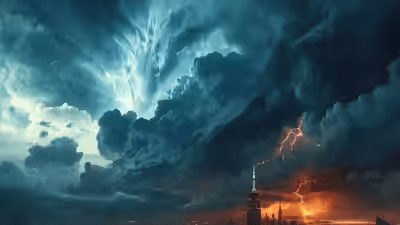
A Solar Shockwave Hits Earth
On the night of 14 November 2025, millions across the Southern Hemisphere looked up to witness a spectacle normally reserved for the poles: a sky awash in glowing ribbons of red, green, purple, and sapphire light. Hours later, NASA confirmed what skywatchers already sensed—Earth had been hit by the strongest geomagnetic storm of the year, a rare G4–G5 level solar event that electrified the atmosphere and dazzled two continents.
Triggered by a massive coronal mass ejection (CME) launched from a volatile sunspot region, the storm slammed into Earth’s magnetosphere with unexpected force, igniting the Aurora Australis so intensely that it was visible as far north as Queensland, Western Australia, and across the entire New Zealand archipelago.
🌠 A Night of Living Light
From remote New Zealand beaches to the suburbs of Melbourne, the night sky shimmered with curtains of charged particles painting the heavens in motion.
“It was like watching neon waves ripple across an invisible ocean,” said Erin Harper, a photographer in Tasmania.
“The colours were so bright they reflected off the water.”
In Christchurch, residents stepped onto balconies to find the southern horizon pulsing like a giant cosmic heartbeat. Farmers, pilots, hikers, and night-shift workers all joined the chorus of astonished witnesses.
Across social media, photos exploded in real time—timelapses of swirling greens, arcs of electric red, and rare ‘proton aurora’ flashes that lit the sky like pink lightning.
☀️ Behind the Storm: A Sun at Its Peak
The Sun is in the most active phase of Solar Cycle 25, and scientists have been watching a rapidly growing sunspot cluster with a complex magnetic field—an ideal setup for powerful eruptions.
According to NASA’s Space Weather Prediction Center:
“This CME was exceptionally fast and magnetically well-oriented for strong geomagnetic impact.” — Dr. Elena Ramirez, Solar Physicist, NASA
When the CME’s magnetic field aligned opposite to Earth’s, the collision sent charged particles spiralling down the poles, supercharging the upper atmosphere and expanding the auroral ring far beyond its usual boundaries.
⚡ Did the Storm Cause Any Problems?
Despite its strength, the event caused minimal operational disruption:
- Brief high-frequency radio blackouts
- Minor GPS drift affecting aviation and maritime operations
- Isolated interference in satellite communication
- Power grids entered protective mode, but no widespread outages were reported
Utility companies in Australia and New Zealand activated “storm hardening” protocols developed after previous solar cycles—measures that proved effective.
🛰️ The Science of a Geomagnetic Storm
(Magazine Technical Box)
What happened?
A coronal mass ejection ejected billions of tons of magnetized plasma into space.
How did it reach Earth?
The CME travelled over 2,000 km/s, reaching Earth in roughly 36 hours.
Why was the aurora so bright?
The storm compressed Earth’s magnetosphere and allowed high-energy electrons to penetrate deeper into the atmosphere, producing intense emissions of oxygen (green/red) and nitrogen (purple/blue).
How rare is this?
G5 storms occur only a handful of times each solar cycle.
🌍 A Shared Moment Across Nations
For many, this event became a reminder of the Sun’s immense power—and beauty. Astronomers called it “the most accessible aurora event in two decades.” Tourism operators in New Zealand reported impromptu midnight crowds rushing to open fields and dark-sky viewpoints.
In Australia, even cities like Adelaide and Perth saw faint glows on the horizon, something unheard of during normal solar conditions.
🔭 What Comes Next?
NASA and NOAA are monitoring the active solar region responsible for the CME. More eruptions are possible, though none currently threaten Earth.
As Solar Cycle 25 approaches its peak, scientists expect more significant solar events in 2025–26, offering both challenges and rare celestial wonders.
“We’re living in one of the most visually dramatic phases of the solar cycle,” says NASA’s Dr. Ramirez.
“People should keep their eyes on the sky.”
🌌 The Final Word
The strongest geomagnetic storm of 2025 was not just a scientific event—it was a collective experience, uniting people across continents in awe of our planet’s cosmic connection.
For one unforgettable night, the heavens opened, and the world looked up.

 SAMSIDDHA@AI