The global seed industry is operating under unprecedented pressure. Climate volatility, escalating biotic and abiotic stresses, rising R&D costs, and shortening commercial product lifecycles are forcing breeders to deliver superior varieties faster than ever before. Traditional plant breeding—while scientifically robust—was never designed for this pace of change.
Artificial Intelligence (AI) is now emerging as a foundational capability that is reshaping plant breeding from an empirical, multi-season process into a predictive, data-driven discipline. By integrating genomics, phenomics, and environmental intelligence, AI is compressing breeding cycles, increasing selection accuracy, and enabling the development of resilient, high-performing varieties that deliver measurable value to farmers and seed companies alike.
From Field-First to Prediction-First Breeding
Conventional breeding relies heavily on multi-year field evaluations to identify superior genotypes. While effective, this approach is slow, resource-intensive, and increasingly misaligned with climate uncertainty.
AI enables a shift from field-first selection to prediction-first decision-making. Machine learning models trained on historical genomic, phenotypic, and environmental data can now predict breeding values, yield potential, and stress responses early in the breeding pipeline—often before large-scale field trials are completed.
This predictive capability fundamentally changes breeding economics. Inferior lines are discarded earlier, elite material advances faster, and fewer resources are spent on low-probability outcomes.
Genomic Selection: Unlocking Faster Genetic Gain
Genomic selection is one of the most mature and impactful AI applications in plant breeding. Advanced machine learning models—such as Random Forests, Gradient Boosting, deep neural networks, LSTMs, and transformer-based architectures—predict genetic merit directly from genome-wide marker data.
Unlike classical linear models, these AI approaches capture:
- Nonlinear gene–gene (epistatic) interactions
- Complex genotype–environment relationships
- Trait architectures governed by hundreds or thousands of loci
As a result, breeders can make confident selection and crossing decisions without waiting multiple seasons for phenotypic confirmation.
Reinforcement learning further elevates this capability by treating breeding as a sequential optimization problem. These algorithms continuously refine parent selection, crossing strategies, and resource allocation across generations to maximize long-term genetic gain.
Industry impact: Breeding cycles that once took 8–10 years can be compressed by several years without sacrificing accuracy—often with higher success rates.
Automated Phenotyping at Scale: Removing the Bottleneck
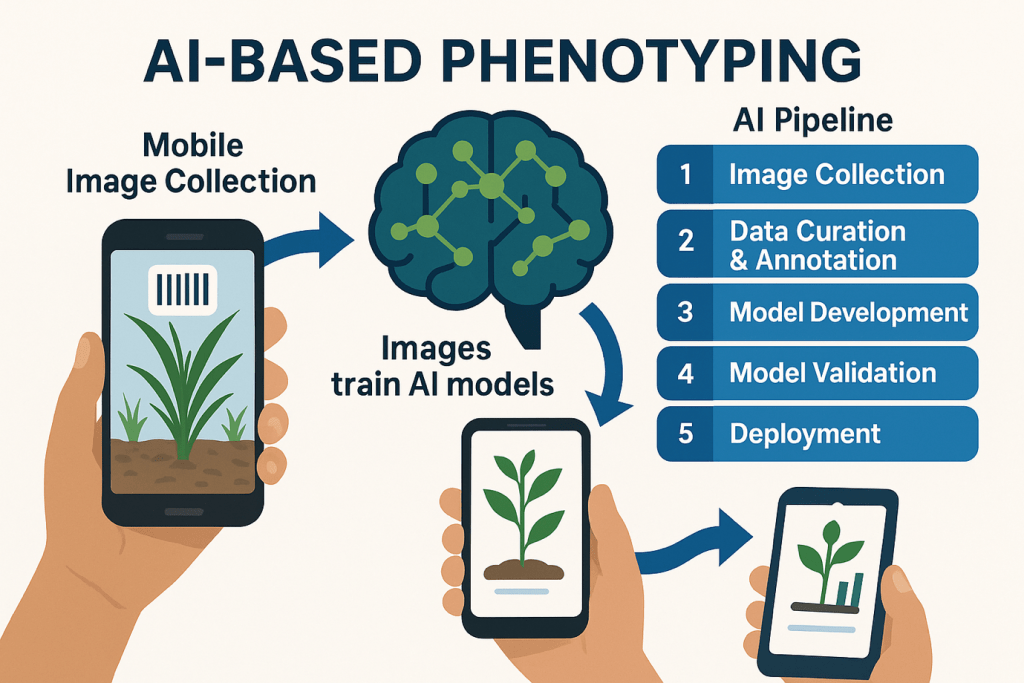
Phenotyping has historically been the slowest and most expensive component of breeding programs. AI-powered computer vision is now removing this bottleneck.
Deep learning models analyze imagery from drones, ground-based sensors, LiDAR, and hyperspectral platforms to extract high-throughput phenotypes related to plant architecture, biomass, vigor, stress response, and yield proxies. These systems deliver consistent, objective measurements across locations and seasons—at a scale impossible with manual scoring.
Mobile, AI-enabled phenotyping tools extend this capability directly to the field. Smartphone-based systems provide instant trait predictions, enabling breeders to make real-time decisions across diverse environments.
Industry impact: Faster phenotyping accelerates selection decisions, reduces labor costs, and enables larger, more informative breeding populations.
Multi-Omics Integration: Breeding for Stress Resilience
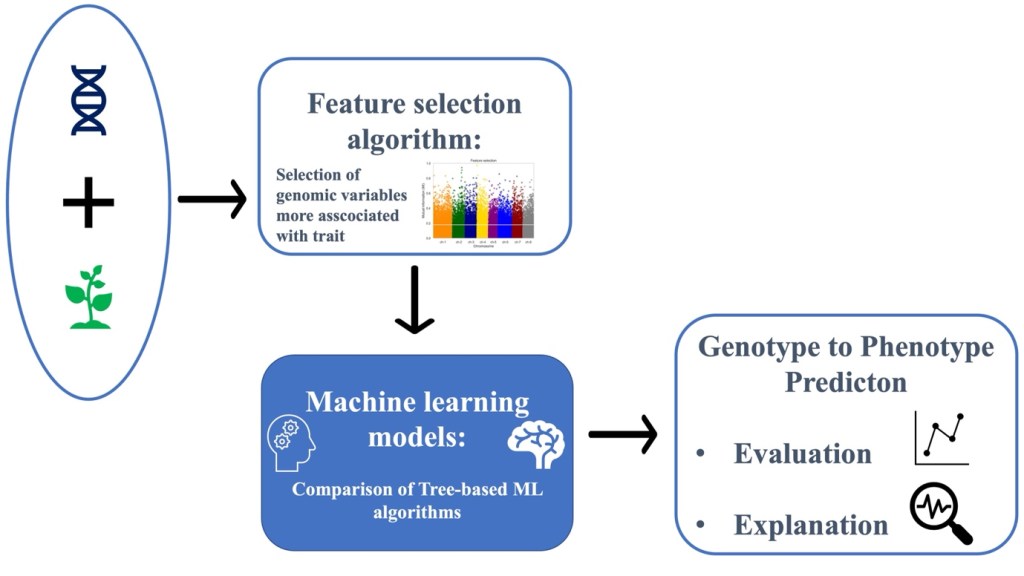
Addressing drought, heat, salinity, pests, and diseases requires understanding complex biological systems rather than single-gene traits. AI excels at integrating multi-omics datasets—genomics, transcriptomics, metabolomics—together with environmental variables.
These models:
- Disentangle genetic effects from environmental noise
- Identify key genomic regions and regulatory elements driving stress tolerance
- Predict performance stability across variable climates
Importantly for commercial breeding, explainable AI techniques highlight which markers and genomic regions drive predictions. This transparency builds confidence in deployment decisions and supports marker-assisted selection, gene editing, and trait stewardship strategies.
Ideotype Design and Intelligent Parent Selection
AI enables a move beyond incremental improvement toward ideotype-driven breeding. Computational models simulate millions of trait combinations under different environmental and management scenarios to identify plant architectures optimized for future conditions.
Coupled with evolutionary algorithms, these systems:
- Identify ideotypes with superior photosynthetic efficiency and yield potential
- Predict hybrid performance before physical crosses are made
- Recommend parent combinations with the highest probability of success
Reinforcement learning agents further optimize these decisions by learning which breeding strategies deliver the greatest long-term returns.
Industry impact: Fewer failed crosses, faster convergence toward elite germplasm, and improved return on R&D investment.
Delivering Value to Farmers and the Seed Industry
For seed companies, AI-driven breeding is not simply a technological upgrade—it is a strategic differentiator. Faster breeding cycles reduce development costs and shorten time-to-market. Improved prediction accuracy increases the likelihood that released varieties succeed commercially.
For farmers, the benefits are tangible:
- Higher and more stable yields under stress conditions
- Reduced crop losses due to pests and diseases
- Improved input-use efficiency and profitability
This alignment of breeder efficiency and farmer value strengthens trust in seed brands and supports long-term market leadership.
Conclusion: AI as Core Breeding Infrastructure
AI is no longer an experimental add-on in plant breeding—it is rapidly becoming core infrastructure. By integrating genomic selection, automated phenotyping, multi-omics intelligence, and ideotype optimization, AI is transforming how new varieties are developed, evaluated, and commercialized.
As climate uncertainty intensifies and the demand for resilient productivity grows, seed companies that embed AI deeply into their breeding pipelines will be best positioned to deliver superior genetics—faster, more reliably, and at scale.
AUTHOR BIO
Tarak Dhurjati is a strategic policy analyst and senior consulting professional with experience spanning Agri-biotechnology, life sciences, and innovation-driven enterprises. An alumnus of IIM Ahmedabad, he has worked with the Indian Council of Agricultural Research (ICAR), PwC, Grant Thornton, Nuziveedu Seeds Limited (NSL) He currently focuses on AI-enabled decision intelligence, life sciences & biotechnology innovation, and AI -driven agricultural transformation.

 SAMSIDDHA@AI