Mar 29, 2026
For decades, economic strategy—both globally and in India—has revolved around a single number: GDP. Governments track it obsessively, global institutions forecast it with precision, and policy frameworks are built around nudging it upward. The IMF and World Bank project global growth at around 3.3% for 2026, supported by incremental policy adjustments and technological offsets. Yet, despite increasingly sophisticated models, these forecasts repeatedly miss the mark. The problem is not just statistical error—though forecast deviations of 0.5–0.6% are common—it is conceptual. Macroeconomic models are built on assumptions of continuity, while real economies evolve through disruption. Innovation shocks, technological leaps, and nonlinear transformations remain fundamentally underrepresented in traditional forecasting frameworks.
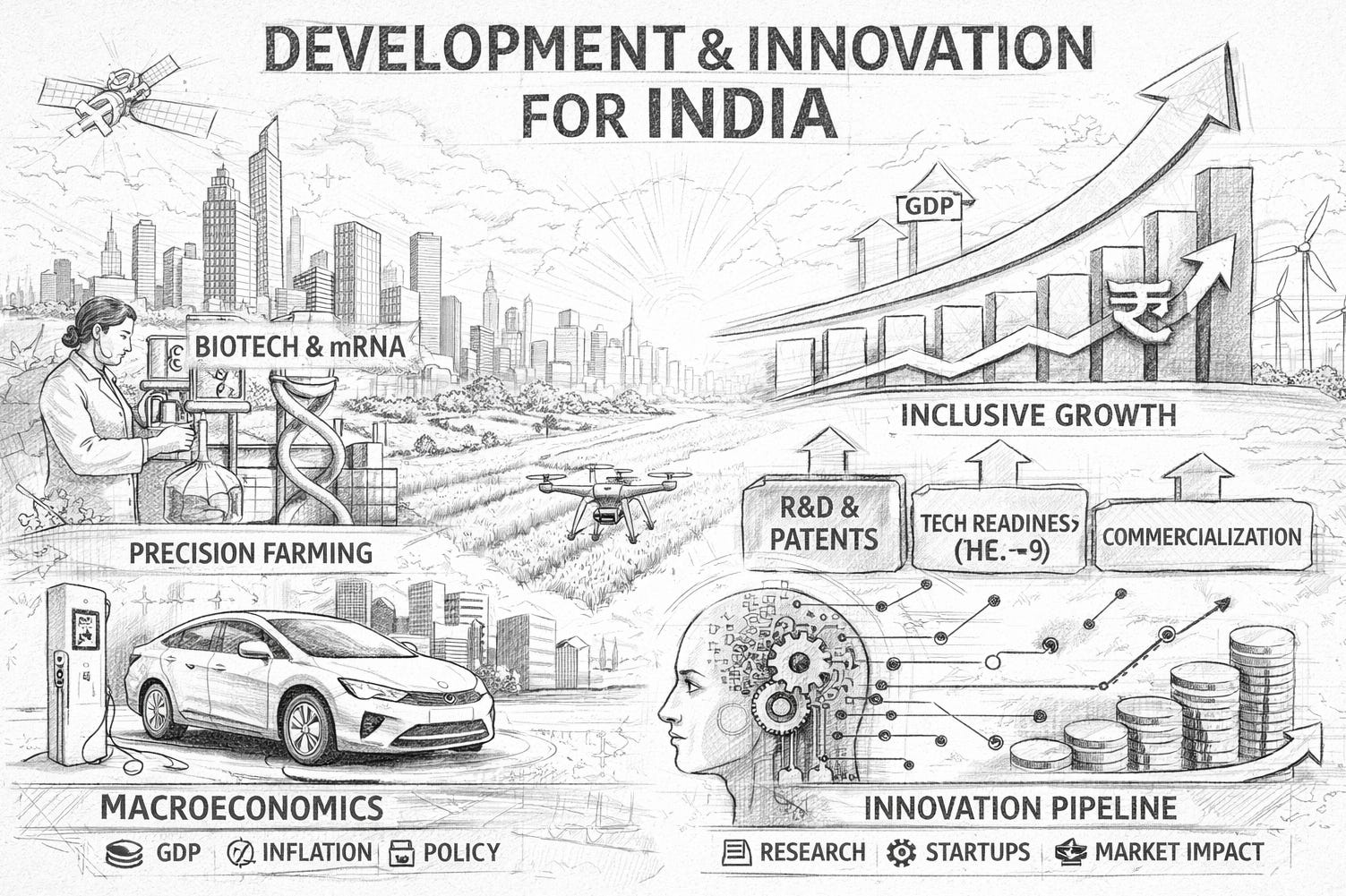
India’s own policy evolution reflects a similar paradox. The transition from the Planning Commission to NITI Aayog in 2015 was framed as a structural shift—from centralized planning to cooperative federalism and strategic advisory. In many ways, this transition has delivered tangible benefits. NITI Aayog has fostered competitive federalism through state rankings, driven initiatives like the Aspirational Districts Programme, and produced forward-looking reports on artificial intelligence, electric mobility, and water management. However, beneath these improvements lies an unchanged core: India’s development thinking remains anchored in GDP-centric logic. NITI Aayog, unlike its predecessor, lacks financial allocation authority, limiting its ability to translate strategy into execution. More critically, there is no unified system to track innovation in real time—no national framework measuring technology maturity, commercialization rates, or the conversion of innovation into economic output. The result is a fragmented approach, where ministries operate in silos and innovation ecosystems fail to scale cohesively. India, in effect, has upgraded its institution without upgrading its development paradigm.
This gap points to a deeper issue: GDP measures outcomes, not transformation. It captures the size of economic activity but not the quality or trajectory of change. It overlooks innovation spillovers, platform effects, and the compounding impact of technological breakthroughs. While alternative metrics—such as well-being indices or sustainability indicators—attempt to address these shortcomings, they still focus on outcomes rather than the engines that drive them. What India needs is not just a broader dashboard of indicators, but an entirely new layer of measurement: innovation accounting. This would include tracking R&D intensity, patent velocity, Technology Readiness Levels (TRL 1–9), commercialization success rates, and sector-specific innovation multipliers. Such a system would shift policy from forecasting growth to engineering it—mapping how ideas move from labs to markets and ultimately to GDP.
The power of this approach becomes evident when we examine how single innovations can transform entire sectors. In biotechnology, automated bio-foundries—operating at mid-to-high TRL levels—are redefining manufacturing itself. By enabling rapid design, testing, and production of biological materials, they have the potential to replace petrochemical-based processes across industries ranging from textiles to food to pharmaceuticals. A single innovation platform thus cascades into multiple value chains, creating export opportunities and high-skill jobs. Similarly, in pharmaceuticals, mRNA technology represents not just a breakthrough product but a scalable platform. It allows the rapid development of multiple therapies—from vaccines to cancer treatments—compressing timelines and generating high-margin intellectual property. For India, the strategic shift here is clear: moving from generic manufacturing to platform-based innovation.
In agriculture, the impact of innovation is less dramatic but more expansive. AI-driven precision farming—leveraging satellite imagery, drones, and real-time analytics—enables farmers to optimize inputs and improve yields. The gains per farmer may appear incremental, but when multiplied across millions of smallholders, the aggregate impact on productivity and income is enormous. This is the essence of innovation-driven growth: small efficiencies at scale translating into macroeconomic acceleration. In the digital economy, large language models and AI systems are emerging as foundational infrastructure. Unlike previous technological waves that created new sectors, AI enhances productivity across all sectors simultaneously—reducing costs, enabling new services, and expanding the scope of what human labor can achieve. Estimates suggest that AI could contribute $500–600 billion to India’s GDP by 2035, not by adding a single industry, but by upgrading the entire economy.
Transport offers another illustration of how innovation reduces economic friction. Autonomous driving systems, combined with electric vehicle ecosystems and vehicle-to-everything (V2X) communication, are poised to transform logistics and mobility. By improving asset utilization and reducing transit inefficiencies, these technologies directly enhance economic productivity. In a country like India, where logistics costs remain high relative to GDP, such innovations have disproportionate impact. They do not merely create new markets—they make existing ones more efficient.
Taken together, these examples point to a fundamental shift in how development must be understood. Growth is no longer the result of capital accumulation and labor expansion alone; it is increasingly driven by the ability to discover, scale, and commercialize innovation. This requires a corresponding shift in policy. India must build an “innovation ledger” that tracks technological progress across sectors, create mission-driven programs focused on high-impact areas like bio-manufacturing and AI, redesign incentives to reward outcomes rather than inputs, and integrate fragmented policy domains into cohesive innovation ecosystems. The role of the state must evolve from planner to catalyst—enabling experimentation, amplifying successful pathways, and aligning incentives with long-term transformation.
The stakes are strategic. Nations that continue to rely on GDP-centric planning will find themselves trapped in incremental growth cycles, perpetually catching up but rarely leading. Those that embrace innovation-centric frameworks, by contrast, can convert scattered breakthroughs into sustained national momentum. India stands at this crossroads. It has the talent, the market scale, and the early signals of innovation across sectors. What it lacks is a unifying framework to harness these forces.
GDP will remain an important measure—but it is no longer sufficient as a guiding principle. The real question is not how fast the economy grows, but how it transforms. The future of development will not be written in economic forecasts or policy documents alone. It will be built in laboratories, startups, farms, and factories—where ideas are turned into systems, and systems into economic power. Nations that learn to measure and scale this process will define the next era of growth. Those that do not will continue to chase it.

 SAMSIDDHA@AI